New to birding?

Start right where you are.

You don't need a life list, a fancy camera, or a field guide memorized. If you've ever stopped to watch a bird, you've already started. Here's a friendly lay of the land, and a few easy ways to get involved with us.

Ways to bird

There's no right way to do this. Here are a few styles people tend to fall into. Mix and match, or make up your own.

Slow birding

Pick a spot, get comfortable, and watch what happens. You might see three birds in an hour and get to know each one pretty well. It's less about finding birds and more about noticing them.

This might be you if you'd rather watch one scrub-jay bury an acorn than chase ten species before lunch.
Listing

Some people like keeping track: a life list, a year list, a list of every bird seen from the kitchen. Apps like eBird make it easy, and your sightings help scientists too.

This might be you if you love a good checklist and a little friendly competition, mostly with yourself.

Birding by ear

Birds are usually heard long before they're seen. Learning a few calls turns a noisy morning into a conversation you can follow, and it works just as well with your eyes closed.

This might be you if you've ever wondered who's making that racket outside your window at 5 a.m.

Backyard and window birding

A feeder, a birdbath, or a comfy chair by the window all count. Watch the same birds day after day and you'll start to learn their habits (and their squabbles).

This might be you if your best birding happens with a cup of coffee in hand.

Birding for every body

Birding is for everyone. No ifs or buts about it. Whoever you are, you're welcome at PVBA, and that very much includes birders with disabilities. If there's anything that would make an outing or a meeting easier for you, just let us know. We're glad to help.

That's why we support Birdability, a nonprofit working to make birding welcoming and accessible for everyone, including people with mobility challenges, blindness or low vision, and other disabilities or health concerns.

Gear to get started

You probably already own everything you need.

  • Notebook and pen
  • Water
  • A snack
  • Sunscreen and a hat
  • Bug repellent
  • Comfortable shoes and clothes
  • A field guide (optional)
  • A field bag (any small bag works)

Birding tips

None of this is required. It just makes the birds a little easier to find, and a little happier to be found.

  • Go early

    Birds are busiest in the first few hours after sunrise. In the Pomona Valley, that's also before the heat sets in.

  • Wear muted colors

    Earth tones and soft colors spook birds less than bright white or neon. Your old olive jacket finally has a purpose.

  • Slow down and be still

    Move slowly and pause often. Birds that scattered when you arrived often come back once you've been still and quiet for a minute.

  • Listen before you look

    You'll hear far more birds than you see. Follow the sound, or let Merlin tell you who's singing.

  • Keep your eyes on the bird

    When you spot one, keep watching it and bring your binoculars up to your eyes. Look down at them first and the bird will be gone.

  • Size and shape first, color second

    Is it sparrow-sized, robin-sized, or crow-sized? Does it hop or walk? Shape and behavior hold up better than color, especially in bad light.

  • Learn your backyard regulars

    A handful of locals make up most of what you'll see: House Finch, Mourning Dove, California Towhee, Black Phoebe, and Anna's Hummingbird. Know them, and the newcomer stands out.

  • Give birds space

    Keep your distance, especially near nests, and stay on the trail. A good look is never worth stressing a bird.

Two free apps we love

Your phone can be a surprisingly good birding buddy. Both of these are free, both come from the Cornell Lab of Ornithology, and each one suits a different kind of birder.

Merlin Bird ID

Think of Merlin as a patient friend who never gets tired of "what was that?" Snap a photo, let it listen to a song, or answer three quick questions, and it'll suggest who you're looking at. It even works offline, which is handy when the birds are out past the cell towers.

Who it's for Slow birders, backyard watchers, and anyone who's ever squinted out the window and wondered who's visiting the feeder.
Get Merlin (opens in a new tab)

eBird

eBird turns your sightings into science. Keep checklists, watch your life list grow, and see what's been spotted nearby (or anywhere in the world) before you head out. Every checklist you share helps researchers keep tabs on how birds are doing.

Who it's for Listers, travelers, and the scientifically curious. If you've ever enjoyed a good spreadsheet, you'll feel right at home.
Get eBird (opens in a new tab)

Come say hello

We run all kinds of outings, from easy, beginner-friendly mornings to longer, more strenuous days in the field. Every trip lists its difficulty, so you can choose the ones that suit you, and our leaders are always happy to answer questions. Monthly meetings are free and open to all, just bring your curiosity!

See upcoming outings and meetings
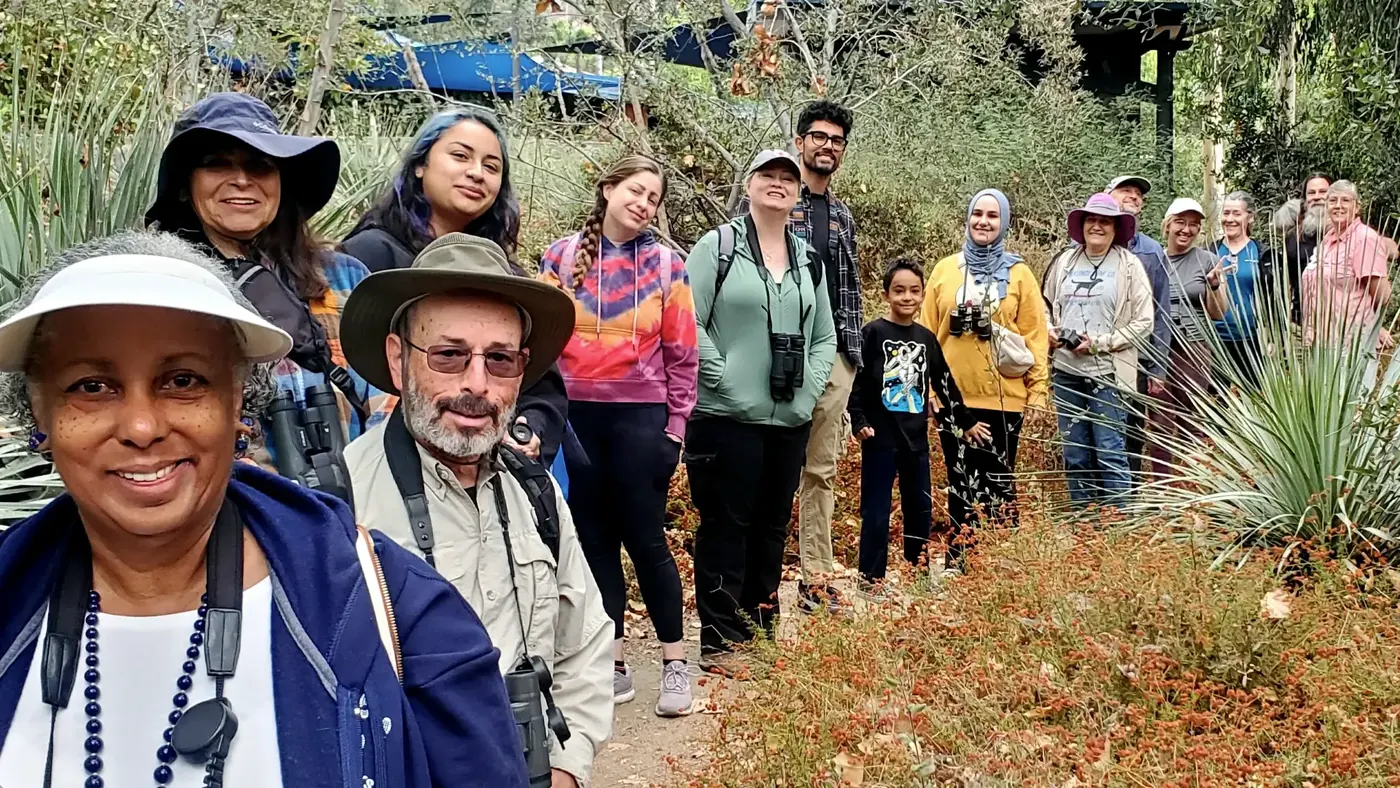
A group of smiling birders of all ages, many with binoculars, lined up along a garden trail